.webp)


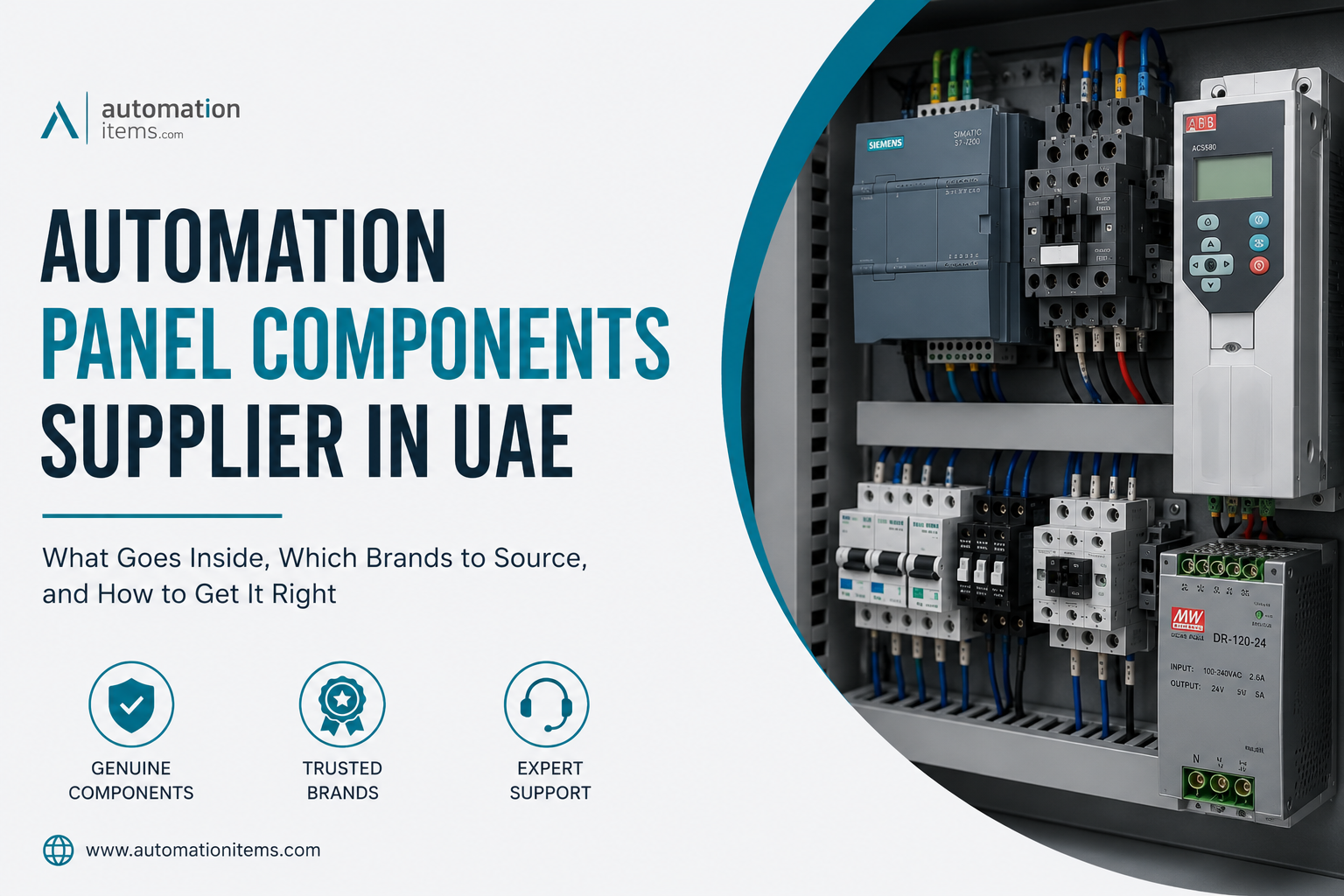
A panel that trips, faults, or fails to talk to the PLC it was built around usually traces back to one of two problems: a component that was specified wrong for the application, or a part sourced from the wrong supplier grey-market stock, no documentation, no support when something goes wrong. For panel builders, system integrators, and maintenance teams working across the UAE’s industrial sector, getting both of these right matters more than almost any other procurement decision in the project.
This guide covers the core components that go into an industrial automation panel, how to match them to the right brands and applications, and what to check before choosing a supplier in the UAE.
What Are Automation Panel Components?
An automation panel is the enclosure that houses all the electrical and control hardware running a machine, process line, or building system. The panel itself, the metal cabinet, the DIN rails, the cable trays is just the shell. What makes it work is the components assembled inside it.
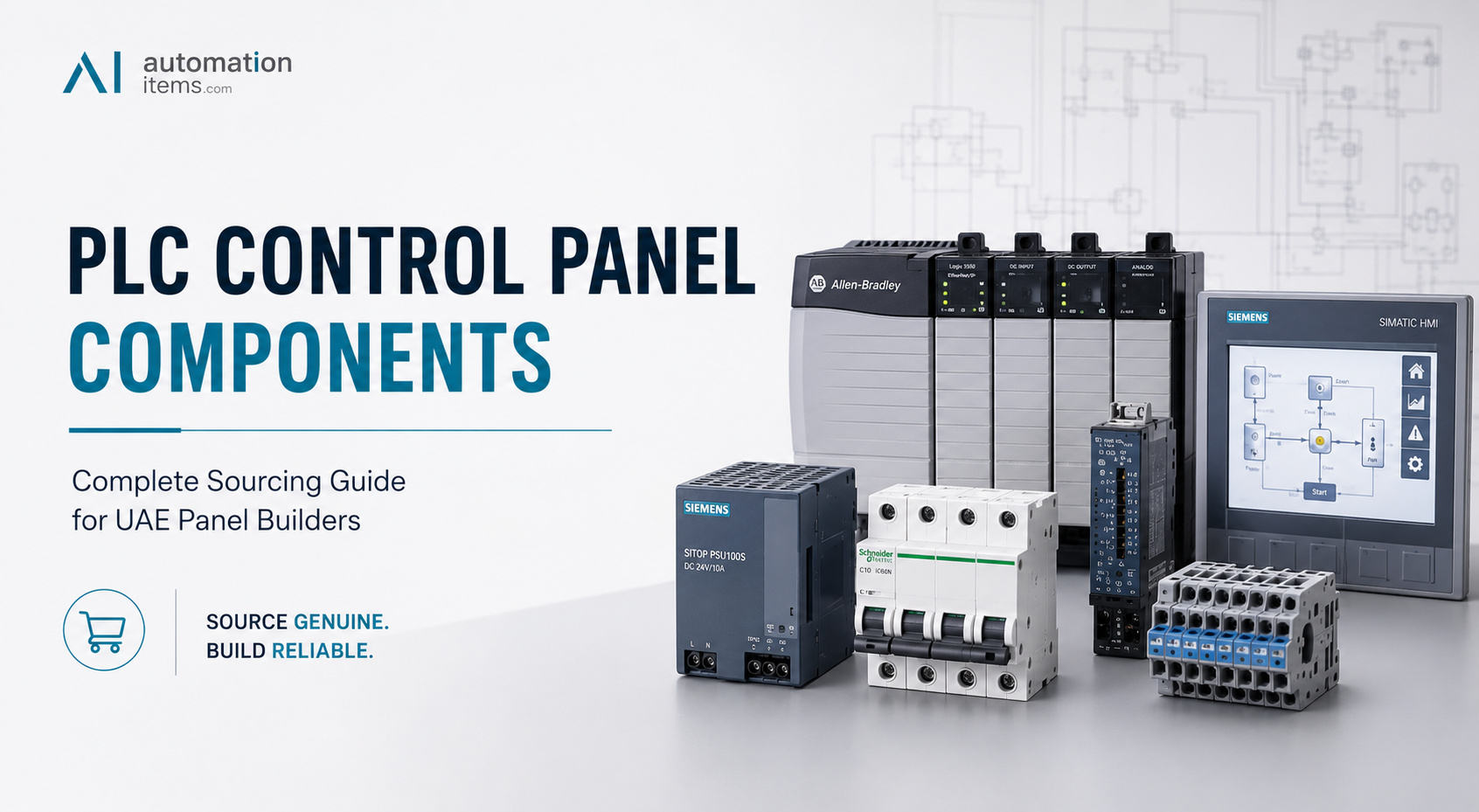
Those components fall into two broad roles. The first is to control the PLCs, HMIs, and I/O modules that decide what the system does and when. The second is power and protection of the drives, contactors, circuit breakers, relays, and power supplies that switch, move, and safeguard the electrical loads the panel manages.
Getting the component mix right means matching each part to the application, the load, the environment, and the communication protocol the rest of the panel is built around. Getting it wrong means a panel that works on paper and fails on the plant floor.
Two Types of Buyers and Why the Distinction Matters
Most people sourcing automation panel components in the UAE fall into one of two categories, and they have meaningfully different needs from a supplier:
Panel builders and system integrators are sourcing components to build a new panel from scratch a full BOM covering PLCs, drives, HMIs, protection devices, terminal blocks, and power supplies, often against a project timeline with fixed delivery dates. For this buyer, brand compatibility, full BOM availability from one supplier, and confirmed lead times matter most. Sourcing across five different suppliers to complete one panel build adds procurement overhead and introduces compatibility risk.
Maintenance and MRO teams are sourcing a specific replacement part for a panel already running in the field, an exact model match for a contactor that’s failed, a replacement I/O module for a rack that’s been damaged, a drive card no longer in the original supplier’s stock. For this buyer, the priority is exact part number matching, fast local availability, and certainty that the component is genuine and not a grey-market substitute that looks right but isn’t.
A supplier who understands both use cases project BOM sourcing and field replacement is a different proposition from one who just lists parts online.
Core Automation Panel Components by Category and Brand
PLCs (Programmable Logic Controllers)
The PLC is the control brain of the panel. Modern PLCs support multiple IEC 61131-3 programming languages — Ladder Logic, Structured Text, Function Block Diagram which matters practically when a maintenance team needs to modify existing logic without rewriting from scratch. For a deeper look at how PLCs work, see our guide on what a PLC is and how it works in industrial automation.
Siemens S7-1200 and S7-1500 are the most commonly specified PLC platforms across Gulf process and manufacturing industries, configured through TIA Portal and the default choice for plants already standardized on Siemens architecture.
Allen-Bradley CompactLogix and ControlLogix dominate US-standard engineering specifications common across UAE manufacturing, logistics, and oil & gas facilities built around Rockwell’s FactoryTalk ecosystem. See our Allen-Bradley vs Siemens PLC comparison for a practical breakdown of when each platform makes more sense.
Schneider Electric Modicon M340 and M580 are well-established in water/wastewater, building automation, and process control, particularly on projects already using Schneider’s broader switchgear and drive portfolio.
Mitsubishi Electric MELSEC series PLCs are common in machine-building and discrete manufacturing, particularly where Mitsubishi servo drives are part of the same control architecture.
Omron Sysmac NX/NJ controllers unify PLC, motion, and vision in one platform suited to packaging lines and high-speed discrete manufacturing where those functions need tight synchronization.
HMIs (Human-Machine Interfaces)
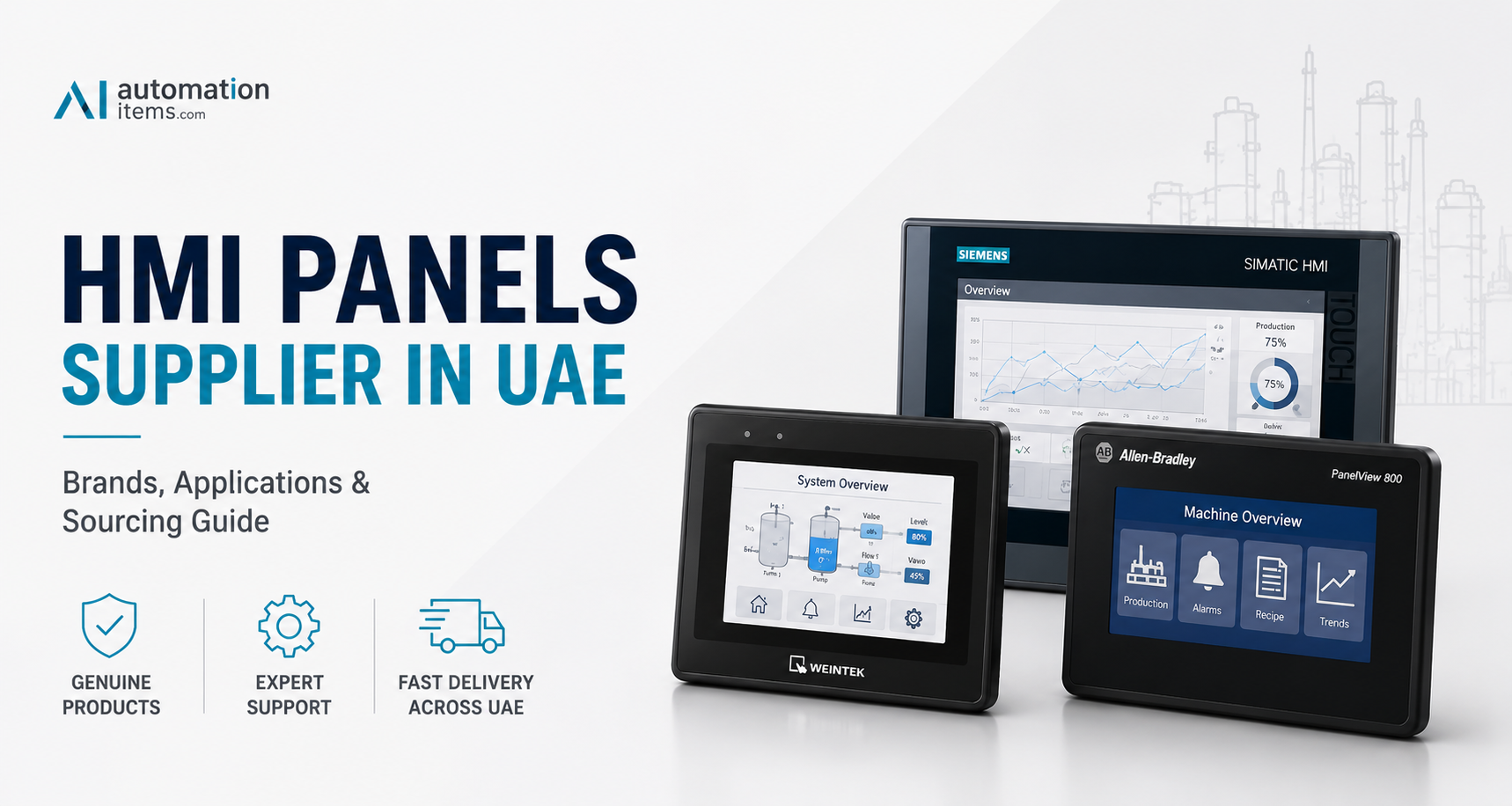
For a full brand-by-brand breakdown of HMI options available in the UAE, see our dedicated HMI Panels Supplier in UAE guide.
Siemens SIMATIC HMI panels integrate directly with TIA Portal, a significant time-saver on projects where both are specified together.
Weintek cMT series panels support several hundred industrial communication protocols via EasyBuilder Pro, making them a practical choice when the HMI needs to talk to a mixed-brand PLC fleet.
Allen-Bradley PanelView panels integrate natively with FactoryTalk, the natural choice when the rest of the panel is already Rockwell.
Delta HMIs suit OEM machine builders who want reliable PLC connectivity without premium brand pricing, frequently paired with Delta’s own PLC and drive lines.
Drives and VFDs
Adding a VFD to pump, fan, or conveyor motor control is one of the most direct ways to cut panel energy consumption motors running at variable load and fixed speed waste a significant portion of their rated power. See our guide on ABB ACS880 drive applications in heavy industries for application-specific detail.
ABB ACS580 and ACS880 drives are well-established across heavy process industries oil & gas, water treatment, utilities with the ACS880 built specifically for demanding multi-drive applications.
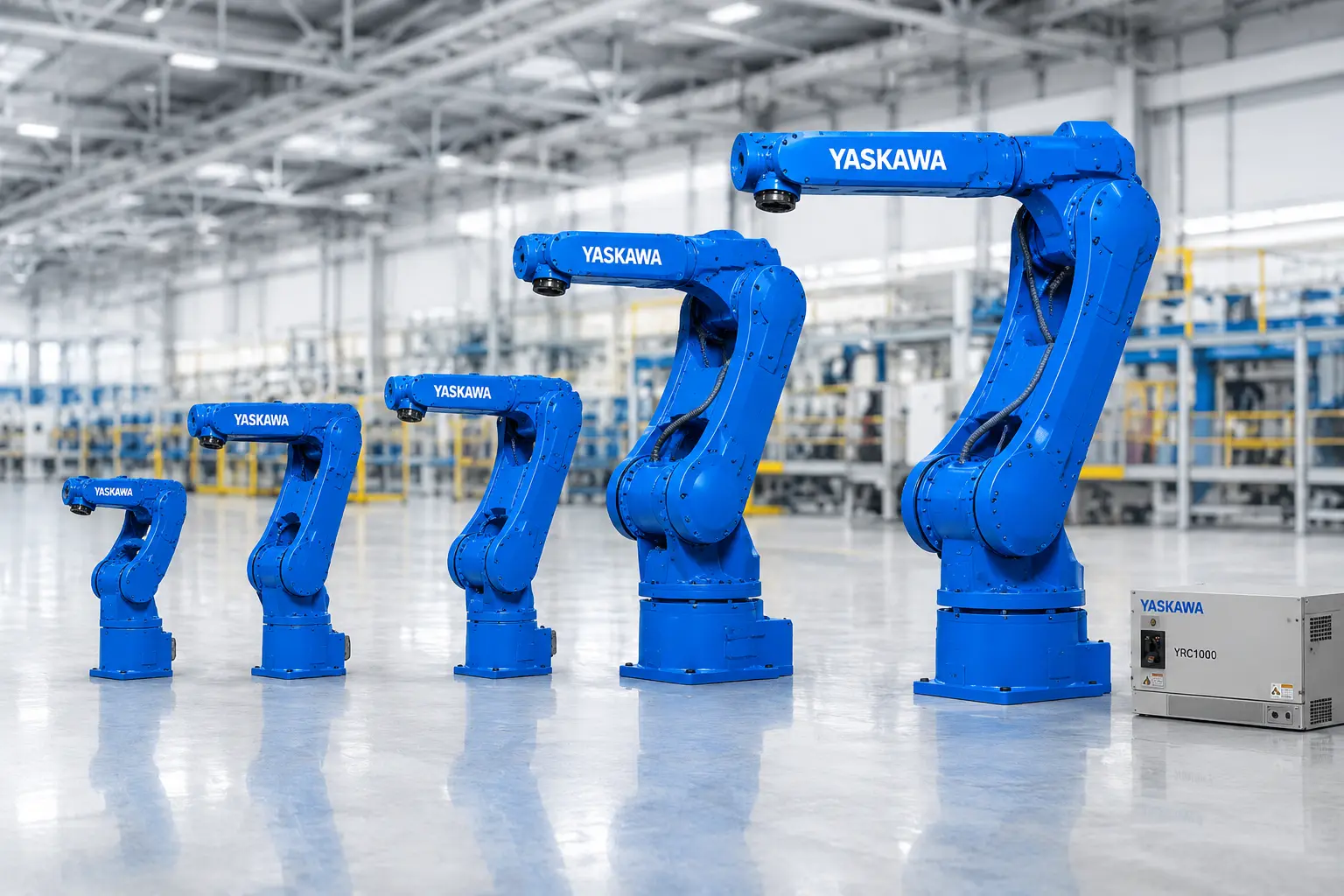
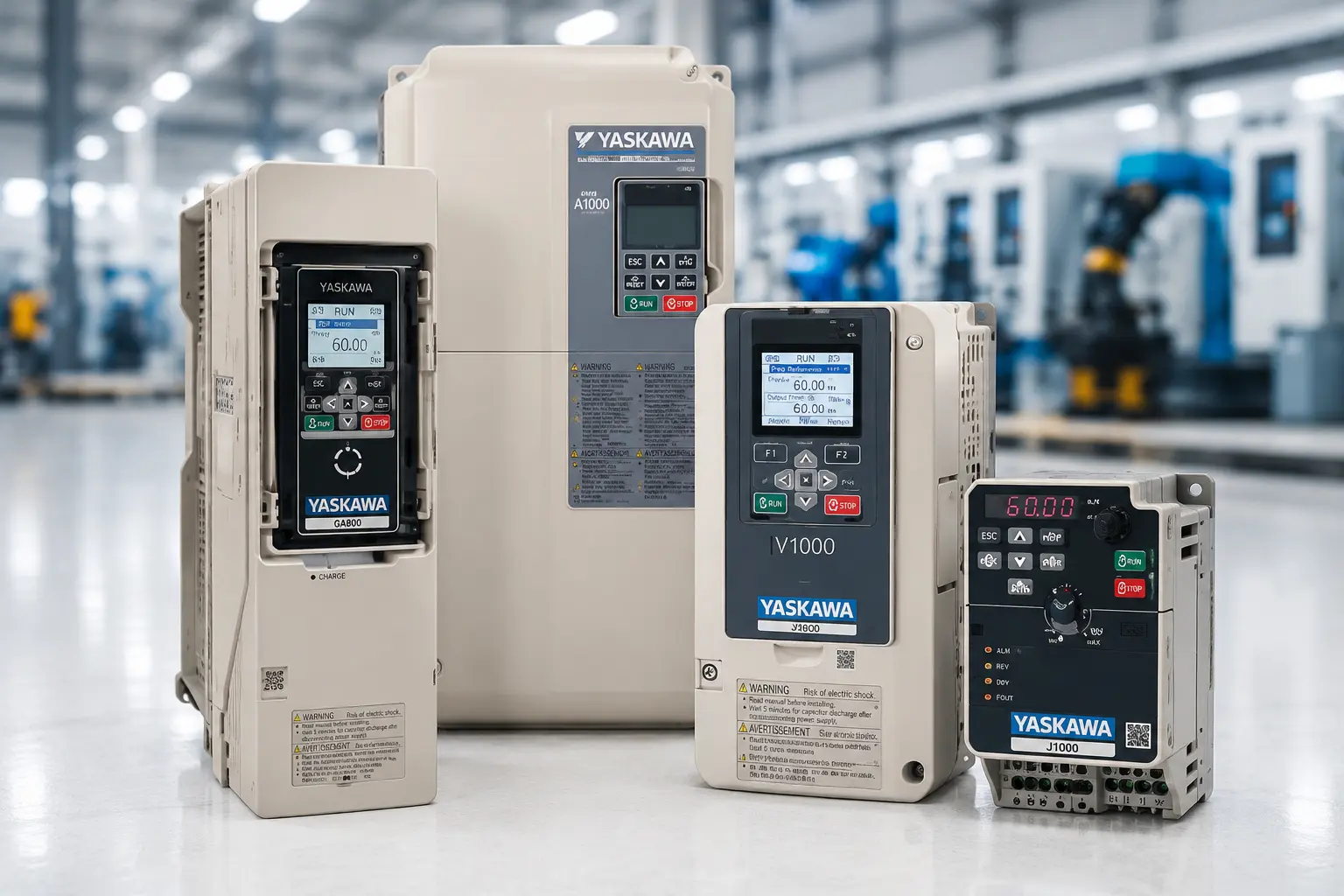
Yaskawa GA500 and A1000 drives are common in motion-heavy applications servo-integrated lines, packaging, material handling where tight speed regulation and fast dynamic response matter.
Schneider Electric Altivar drives cover a wide application range from simple pump/fan control (ATV320) to complex multi-motor coordination (ATV900 series), frequently paired with Schneider PLCs and contactors on single-brand panel builds.
Fuji Electric FRENIC series drives appear in OEM equipment built around Japanese-engineered control architectures conveyor, packaging, and utility-scale applications.
Emerson drives are common in process-heavy environments where the rest of the control architecture is already Emerson, particularly oil & gas and continuous-process plants.
Contactors, Relays, and Motor Starters
Contactors are among the highest-wear components in any panel; they cycle on and off throughout the panel’s operating life, which means brand availability for replacement parts matters as much as the initial specification. For how contactors fit into a complete panel architecture, see our Schneider Electric products guide.
Schneider Electric / Telemecanique TeSys contactors are among the most widely stocked in the UAE, frequently specified alongside Schneider PLCs and protection devices.
Siemens SIRIUS 3RT contactors are the standard pairing for Siemens S7 panels, same brand, same terminal standards, same documentation ecosystem.
ABB AF-series contactors are specified frequently in power distribution and utilities, where ABB’s electrification portfolio already dominates the panel design.
Mitsubishi Electric magnetic contactors are common in panels where Mitsubishi drives and PLCs are already specified.
Circuit Protection
A protection device that’s undersized, incorrectly coordinated, or sourced grey-market is a safety issue, not just a performance one.
Siemens SENTRON and 3RV series MCCBs and motor protection circuit breakers are common across process and manufacturing panels where Siemens is the primary brand.
Schneider Electric GV2/GV3 motor circuit breakers and EasyPact MCCBs are widely used across UAE panel builders, particularly where Schneider contactors and PLCs are already in the same panel.
ABB SACE Tmax and Formula MCCBs are common in power distribution and MCC panels.
Terminal Blocks and Wiring Components
Phoenix Contact is the reference brand for terminal blocks across UAE panel builders — push-in and screw-clamp variants, feed-through and disconnect types, with a well-documented labeling system. Their CLIPLINE complete wiring system is the practical standard in most professionally built panels. For how terminal blocks fit into a complete panel architecture, see our Allen-Bradley industrial automation components guide.
Schneider Electric Linergy terminal blocks suit panels where full Schneider product consistency is preferred across protection, control, and wiring components.
Power Supplies
Siemens SITOP power supplies are the standard pairing for Siemens PLC panels, with load monitoring and diagnostics that integrate with TIA Portal.
Phoenix Contact QUINT and TRIO series are common across multi-brand panels where an independently specified, reliable supply is preferred over a brand-matched unit.
Omron S8VK series are frequently used in Omron Sysmac-based panels.
Sourcing for UAE Conditions
IP ratings matter more here. Sustained outdoor temperatures above 45°C, airborne dust, and coastal humidity push the minimum practical IP rating for panel enclosures and many components higher than European or North American defaults. IP54 is typically the floor for outdoor or semi-exposed installations; IP65 is common for anything in a plant or utilities environment with direct dust or wash-down exposure.
Grey-market risk on branded components is real. Siemens, Allen-Bradley, and ABB components are heavily counterfeited. A component that looks identical to the genuine article can fail under load, fail to communicate on the right protocol version, or carry no valid warranty. Ask for traceability documentation not just a brand name on a label.
Local stock availability directly affects project timelines. A component that needs to be ordered from Europe or Asia adds two to four weeks to a commissioning date. A supplier with genuine regional stock on the components you need most Siemens S7 modules, Allen-Bradley I/O cards, ABB drive components is a real operational advantage, not just a nice-to-have.
For a broader framework on evaluating automation components for your application, see our guide on how to choose the right automation components.
Industries We Serve in UAE
Oil & gas and petrochemical: Siemens, Allen-Bradley, and ABB dominate panel component specifications, driven by hazardous-area certification requirements, existing DCS/SCADA infrastructure, and stringent documentation standards for safety-critical panels.
Water and wastewater treatment: Schneider and Siemens PLCs, ABB and Yaskawa drives, and Phoenix Contact terminal blocks show up consistently across pump station and treatment plant panels, where outdoor IP ratings and wide operating temperature tolerance are baseline requirements.
Manufacturing and packaging: the most component-diverse sector, ranging from full Siemens or Allen-Bradley panel builds on large production lines to cost-optimised Mitsubishi or Delta-based panels on individual OEM machines.
Building automation and facilities management: Schneider and Siemens for control, ABB for power distribution, with growing demand for BMS-integration-ready communication modules across commercial towers and infrastructure projects.
Logistics, ports, and material handling: Allen-Bradley and Yaskawa drive heavy use across conveyor, crane, and AGV applications, often against US or Japanese engineering standards set at the OEM level.
See our Industries We Serve page for the full range of sectors Automation Items supports.
Why Source Through Automation Items
Most component suppliers in the UAE focus on one or two brands and funnel every project toward the same short catalogue. Automation Items stocks panel components across 14 major automation brands covering PLCs, HMIs, drives, contactors, protection devices, terminal blocks, and power supplies so sourcing for a multi-brand panel build or a specific field replacement can happen through one supplier rather than five.
Every component is sourced through documented supply channels. For project BOM sourcing, the team can confirm availability and lead times across the full component list before the order is placed. For MRO replacement sourcing, exact model matching against the part number in the field is the starting point not a “near equivalent” substitution that creates compatibility questions.
Ready to source components for your next panel build or field replacement? Send a quote request with the part numbers, quantities, and required delivery window, and the team will confirm availability and pricing before you commit.
Get a Quote → Browse All Brands →
Frequently Asked Questions
What components go inside an industrial automation panel?
The core components are: a PLC or controller (the control logic), an HMI (the operator interface), drives or VFDs (for motor speed control), contactors and relays (for switching electrical loads), circuit breakers and overload protection (for safety), terminal blocks (for field wiring connections), and a DC power supply (for the control electronics). The exact mix depends on the application a simple pump panel and a multi-axis machine panel have very different component requirements.
What is the difference between a PLC panel and an MCC panel?
A PLC panel is primarily a control panel — it houses the logic controller, I/O modules, and HMI that automate a process. An MCC (Motor Control Centre) is primarily a power distribution and motor-switching panel it houses contactors, starters, overload relays, and protection devices for multiple motors. Many modern panels combine both functions in the same enclosure.
Can I source all automation panel components from one supplier in the UAE?
Yes, if the supplier stocks across the brands and component categories the panel requires — PLCs, HMIs, drives, contactors, protection, terminal blocks, and power supplies. A single-supplier BOM reduces procurement overhead, improves component compatibility, and simplifies documentation. The risk with single-supplier sourcing is a narrower brand range forcing substitutions; a multi-brand distributor avoids that.
How do I verify a component is genuine and not grey-market?
Ask the supplier for traceable sourcing documentation purchase invoices, distributor authorization letters, or certificates of conformity from the manufacturer. Genuine branded components carry the manufacturer’s own labeling, hologram stickers where applicable, and serial numbers that can be verified against the manufacturer’s database. If a supplier can’t provide documentation, that’s the clearest red flag.
Which PLC brand is most commonly used in UAE automation panels?
Siemens and Allen-Bradley (Rockwell Automation) are the two most widely specified PLC platforms across the UAE. Siemens dominates in European-influenced process plants and utilities; Allen-Bradley is common in US-standard facilities, oil & gas, and logistics. Schneider Electric Modicon is a close third across building automation and water treatment. The right choice almost always depends on existing infrastructure and the engineering standard the project was specified against.
Why do UAE automation panels need higher IP-rated components?
The combination of sustained high ambient temperatures, fine airborne dust, and seasonal humidity means components and enclosures need a higher level of ingress protection than in milder climates. IP54 is typically the minimum for semi-exposed locations; IP65 is common for plant environments with active dust or moisture. Components rated for lower IP levels may operate initially but will degrade faster and are more likely to cause nuisance faults under UAE operating conditions.
Final Thoughts
There’s no universal “best” component list for an automation panel — there’s a best combination for the specific PLC platform, load profile, environment, and communication protocol the panel is being built around. Getting that combination right starts with a supplier who understands the application, stocks the right brands, and can confirm availability before the project timeline commits to a delivery date.
Send a quote request with the panel’s requirements, brand preferences, part numbers where known, application environment, and delivery window and the team at Automation Items will come back with availability and pricing across the full list.