.webp)


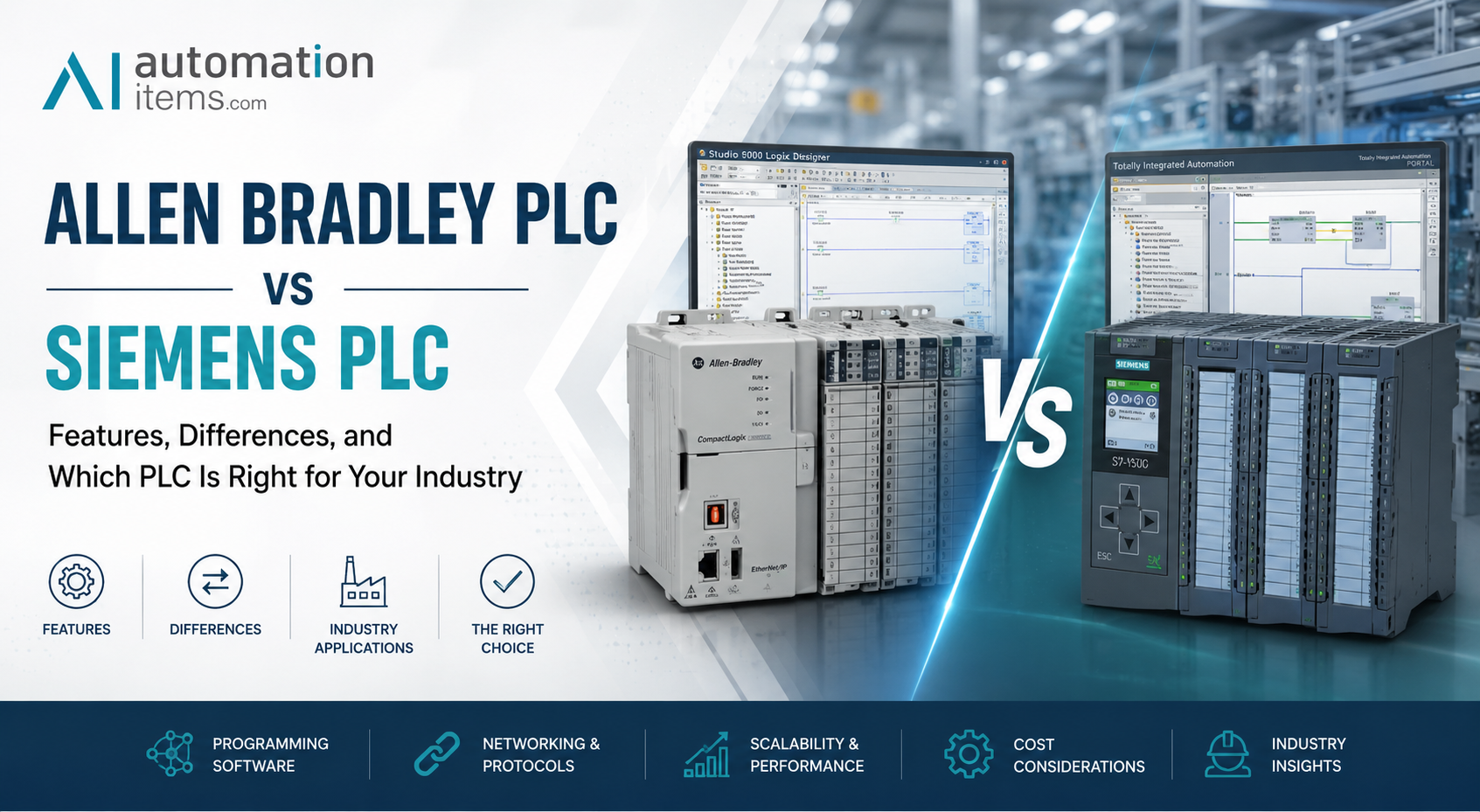
If you are sourcing a PLC for a project in the UAE or wider GCC, two brands come up most often: Allen Bradley (Rockwell Automation) and Siemens. Both are well supported across the region and both can handle most industrial control applications.
There is no single “better” brand. The right choice depends on your application, your existing infrastructure, and what your engineering team already knows. Automation Items stocks both brands across multiple series, so this guide is meant to help you match the PLC to your project — not to push you toward either one.
Quick Comparison
|
Allen Bradley |
Siemens |
|
|---|---|---|
|
Parent company |
Rockwell Automation (USA) |
Siemens AG (Germany) |
|
Strongest regional presence |
North America |
Europe, Asia, and most other regions |
|
Software |
Studio 5000 / RSLogix |
TIA Portal |
|
Programming style |
Tag-based |
Block/address-based (TIA Portal also supports tags) |
|
Native network protocol |
EtherNet/IP |
Profinet |
|
Common strength |
Motion control, discrete manufacturing |
Process control, large-scale integration |
|
Entry-level hardware cost |
Generally higher |
Generally lower at the compact/small PLC tier |
Company Background
Allen Bradley is the PLC brand under Rockwell Automation, headquartered in Milwaukee, USA. It is programmed using Studio 5000 Logix Designer. The platform is widely used across North American automotive, food and beverage, and oil & gas plants.
Siemens is a German industrial company, and its SIMATIC PLC line ranges from the entry-level S7-1200 to the high-end S7-1500. Siemens programs its PLCs, HMIs, drives, and motion control through one software environment, TIA Portal (Totally Integrated Automation Portal).
Both companies have decades of experience building industrial controllers. The differences below are about design approach and regional usage, not about one brand being more capable than the other.
Hardware and Architecture
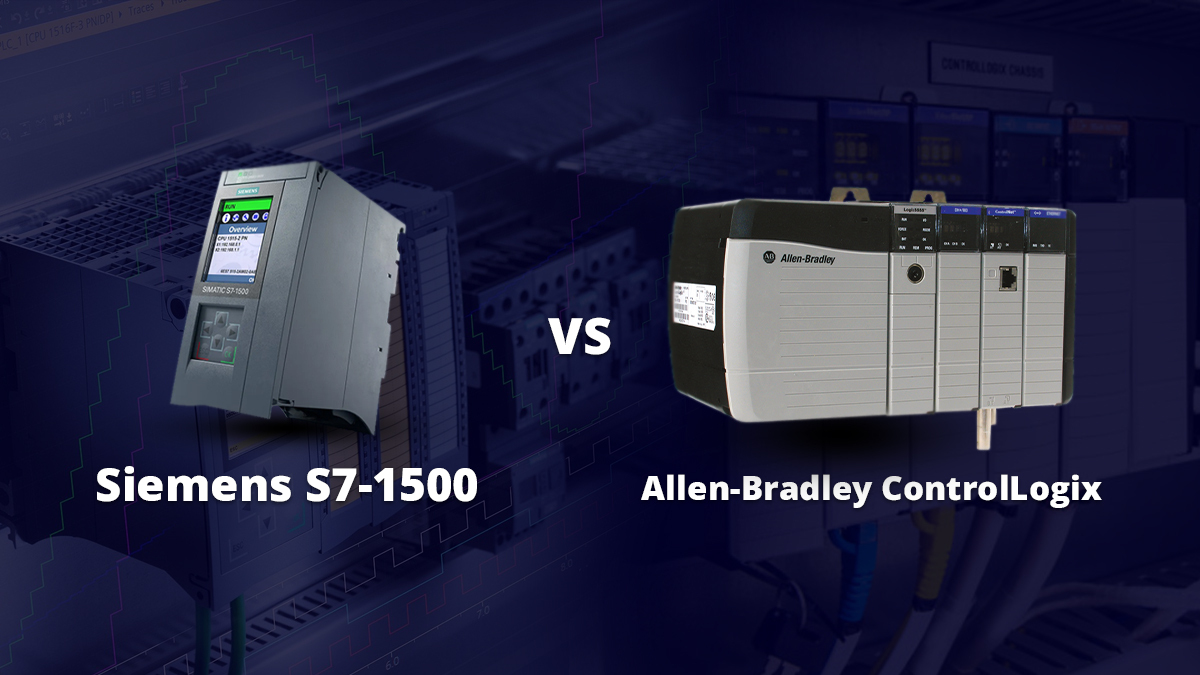
Allen Bradley (ControlLogix, CompactLogix) uses a chassis-based, modular rack. You select a backplane and add the I/O, communication, and processor modules you need. The system is powered by Allen Bradley-specific power supplies that mount directly in the rack. This keeps the system within Allen Bradley's own rack and power ecosystem.
Siemens (S7-1500, ET 200 distributed I/O) also needs a power supply for the backplane and a separate supply for field-side power. However, much of the Siemens line accepts standard third-party 24V DC supplies, which gives more flexibility in panel design. Siemens also supports distributed I/O more directly, letting you place I/O closer to the equipment instead of concentrating it in one rack.
Both designs work well in practice. The difference usually comes down to what your panel builder is used to specifying.
Software: Studio 5000 vs TIA Portal
Studio 5000 uses tag-based programming. You name a tag once and use it anywhere in the project, including HMI screens built in FactoryTalk View. It also supports online editing — changing logic while the system is running — which matters in plants where stopping the line is not an option.
TIA Portal combines PLC programming, HMI design, drives, and motion control in one software environment instead of separate applications. It takes longer to learn at first, but the integration can save time on larger or more complex projects once your team is comfortable with it.
If your maintenance team already knows one platform, that experience is usually worth more than any individual feature. Retraining a team takes real time and budget.
Networking and Protocol Fit
Allen Bradley is built around EtherNet/IP, common across North American-influenced plants and OEM equipment. Siemens is built around Profinet, common across European-engineered machinery and process plants worldwide.
This affects integration time. If your plant already runs Profinet field devices — sensors, drives, motor starters — a Siemens PLC will usually integrate faster. If your plant runs EtherNet/IP devices (common with North American-spec machinery used across UAE industrial zones), Allen Bradley is the simpler fit. Both platforms support OPC-UA for third-party integration, and gateway modules can bridge the two protocols when needed. Matching the PLC to your existing protocol reduces integration work either way.
Industry Fit
Neither brand is restricted to specific industries, but usage patterns differ:
Allen Bradley is more common in:
- Discrete manufacturing and assembly lines
- Automotive and packaging
- Applications needing tight motion control
- Plants with existing Rockwell infrastructure
Siemens is more common in:
- Process industries — oil & gas, water treatment, power generation
- Large-scale or multi-site operations
- Projects following European engineering standards
- Plants already running Profinet field devices
In the UAE, both brands have a strong presence. Allen Bradley is common in oil & gas, petrochemicals, and water/desalination projects. Siemens has a strong footprint in process automation, power, and infrastructure megaprojects. Many GCC facilities run both brands across different parts of the same site — which is why sourcing genuine parts for either brand from one supplier is more practical than committing to a single brand's supply chain.
Cost
At the small/compact tier, Siemens generally has a hardware cost advantage — an entry-level S7-1200 typically costs less than a comparable entry-level CompactLogix. That gap narrows at the mid-range and high-end, where hardware pricing becomes more comparable between the two brands.
Software licensing is a cost on both sides. Neither Studio 5000 nor TIA Portal has a free permanent commercial license. Both offer time-limited trial versions for evaluation, but production use requires a paid license regardless of brand.
Training and engineering time is the cost most often underestimated. A team experienced in one platform will usually complete a project faster on that platform than on one they're learning from scratch. On a tight commissioning deadline, that speed difference can outweigh a small hardware price gap.
How to Decide
- What does your existing plant already run? Standardizing on one brand reduces spare parts inventory and training needs.
- What protocol do your field devices use? EtherNet/IP points to Allen Bradley; Profinet points to Siemens.
- Is this a discrete or process application? Discrete/motion-heavy applications lean Allen Bradley; large-scale process control leans Siemens.
- Does your client or consultant specify a brand? Many UAE projects already have the PLC brand defined in the spec.
- What is your team trained on? This is often the deciding factor in practice.
Summary
Both Allen Bradley and Siemens are reliable, well-supported PLC platforms. The right choice depends on your existing infrastructure, your team's experience, and your project's protocol requirements — not on which brand wins on a spec sheet.
Automation Items supplies both Allen Bradley and Siemens components, along with ABB, Schneider Electric, Mitsubishi, and other brands across our PLC Systems range. You can source parts for either platform without committing to one brand in advance.
Need a specific part number? Browse our PLC Systems catalogue or send us a quick quote and our team will confirm availability and pricing.